Competitive Programming
Chapter 08
Linked lists
L I N E A R A N D L I N K E D
A linked list is a chain of nodes. Each node holds a value and a pointer to the next node. There is no index and no jumping around; to reach the fifth node you walk through the first four. The whole skill here is managing pointers without losing the chain. before 1 2 3 null after 1 2 3 null Reversing means flipping every arrow to point backward, one node at a time.
R E A C H F O R L I N K E D L I S T T E C H N I Q U E S W H E N Y O U S E E
"Reverse the list", "find the middle", "detect a cycle", "merge two sorted lists", "remove the Nth node from the end." The two workhorses are the fast-and-slow pointer (for middle and cycle) and the dummy head node (to simplify insertions and deletions at the front).
The node definition
class ListNode:
    def __init__(self, val=0, next=None):
        self.val = val
        self.next = next
class ListNode {
    int val;
    ListNode next;
    ListNode(int val) { this.val = val; }
}
Worked example: reverse a linked list
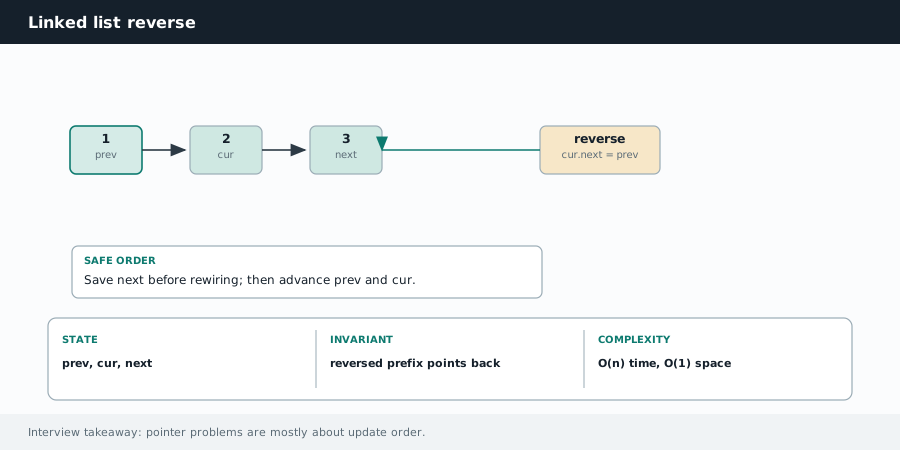
Walk the list. At each node, remember the next node, then point the current node backward at the previous node, then step everything forward. The trap is losing the rest of the chain, so you must save next before you overwrite it.
def reverse_list(head):
    prev = None
    curr = head
    while curr:
        nxt = curr.next      # save the rest of the chain first
        curr.next = prev     # flip the arrow backward
        prev = curr          # move prev forward
        curr = nxt           # move curr forward
    return prev              # prev is the new head
ListNode reverseList(ListNode head) {
    ListNode prev = null, curr = head;
    while (curr != null) {
        ListNode next = curr.next;   // save the rest first
        curr.next = prev;            // flip the arrow
        prev = curr;                 // advance prev
        curr = next;                 // advance curr
    }
    return prev;                     // new head
}
Fast and slow pointers: find the middle, and detect a cycle
Move one pointer one step at a time and another two steps at a time. When the fast one reaches the end, the slow one is exactly in the middle. And if the list secretly loops back on itself, the fast pointer will eventually lap the slow one and they will meet. This is called Floyd's cycle detection, and it uses no extra memory.
def find_middle(head):
    slow = fast = head
    while fast and fast.next:
        slow = slow.next          # one step
        fast = fast.next.next     # two steps
    return slow                   # middle node
def has_cycle(head):
    slow = fast = head
    while fast and fast.next:
        slow = slow.next
        fast = fast.next.next
        if slow is fast:          # they met, there is a loop
            return True
    return False
ListNode findMiddle(ListNode head) {
    ListNode slow = head, fast = head;
    while (fast != null && fast.next != null) {
        slow = slow.next;         // one step
        fast = fast.next.next;    // two steps
    }
    return slow;                  // middle
}
boolean hasCycle(ListNode head) {
    ListNode slow = head, fast = head;
    while (fast != null && fast.next != null) {
        slow = slow.next;
        fast = fast.next.next;
        if (slow == fast) return true;  // they met
    }
    return false;
}
The dummy node trick: merge two sorted lists
When you build a new list or delete from the front, having a fake node in front of the real head saves you from special-casing the first element. You always attach to tail.next and return dummy.next at the end.
def merge_two_lists(a, b):
    dummy = ListNode()        # fake head so we never special-case the start
    tail = dummy
    while a and b:
        if a.val <= b.val:
            tail.next = a
            a = a.next
        else:
            tail.next = b
            b = b.next
        tail = tail.next
    tail.next = a or b        # attach whatever is left
    return dummy.next
ListNode mergeTwoLists(ListNode a, ListNode b) {
    ListNode dummy = new ListNode(0);   // fake head
    ListNode tail = dummy;
    while (a != null && b != null) {
        if (a.val <= b.val) { tail.next = a; a = a.next; }
        else { tail.next = b; b = b.next; }
        tail = tail.next;
    }
    tail.next = (a != null) ? a : b;    // attach the remainder
    return dummy.next;
}
W A T C H O U T
The number one linked list bug is a null pointer error. Before you write node.next.next , be sure node.next is not null. In the fast-and-slow loop, always check fast and fast.next before stepping, in that order. And when reordering pointers, save what you need before you overwrite it, or the tail of your list vanishes.
Deeper Intuition
Why a gap of n finds the end
Two pointers that stay exactly n nodes apart turn "nth from the end" into a single pass. Start the lead pointer n steps ahead, then move both together. When the lead reaches the last node, the trailing pointer is sitting right before the node you want to remove, because the fixed gap guarantees it. A dummy head in front of the list means even removing the first node needs no special case. keep the two pointers a fixed gap of n apart trail lead 1 2 3 4 5 skip node 4 Start one pointer n nodes ahead. When it reaches the end, the other sits just before the target.
Another worked example: Remove Nth Node From End
Delete the nth node counting from the end in one pass. Put a lead pointer n steps ahead of a trailing pointer, then advance both until the lead hits the end. The trailing pointer now points at the node just before the target, so you skip it.
def remove_nth_from_end(head, n):
    dummy = ListNode(0, head)
    lead = trail = dummy
    for _ in range(n):
        lead = lead.next            # move lead n steps ahead
    while lead.next:                # move both until lead is last
        lead = lead.next
        trail = trail.next
    trail.next = trail.next.next    # skip the target node
    return dummy.next
ListNode removeNthFromEnd(ListNode head, int n) {
    ListNode dummy = new ListNode(0, head);
    ListNode lead = dummy, trail = dummy;
    for (int i = 0; i < n; i++) lead = lead.next;   // n ahead
    while (lead.next != null) {                     // move together
        lead = lead.next;
        trail = trail.next;
    }
    trail.next = trail.next.next;                   // skip target
    return dummy.next;
}
Going Deeper
What kinds of problems this solves
U S E T H I S P A T T E R N F O R
Problems where you rewire pointers rather than move data: reversing, detecting or locating a cycle, finding the middle or the kth from the end, and merging or reordering lists.
| Problem type | Classic examples |
|---|---|
| Pointer rewiring | Reverse Linked List, Reverse Nodes in k-Group, Swap Nodes in Pairs, Rotate List |
| Fast and slow pointers | Middle of the Linked List, Linked List Cycle, Linked List Cycle II, Palindrome Linked List |
| Merging with a dummy node | Merge Two Sorted Lists, Merge k Sorted Lists, Add Two Numbers, Remove Nth Node From End of List |
| STEP BY STEP |
S T E P B Y S T E P
Reversing the list 1 to 2 to 3. We keep a previous pointer and, at each node, flip its next to point backward before moving on.
| prev | current | action | list built so far |
|---|---|---|---|
| null | 1 | 1.next = null, prev = 1, current = 2 | null <- 1 |
| 1 | 2 | 2.next = 1, prev = 2, current = 3 | null <- 1 <- 2 |
| 2 | 3 | 3.next = 2, prev = 3, current = null | null <- 1 <- 2 <- 3 |
| 3 | null | current is null, stop, return prev | new head is 3 |
Interview drill — Linked lists
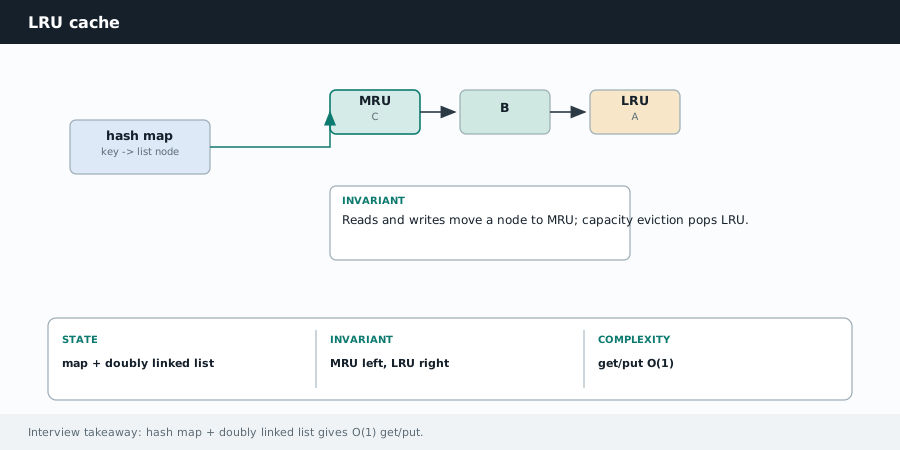
Draw pointers before you mutate — especially for LRU.
More drills in the Interview Lab.
Q1. LRU Cache
Q2. Reverse Linked List
Reverse iteratively and recursively.
prev/curr/next walk. Recursion: reverse rest, then head.next.next=head; head.next=None.
Q3. Linked List Cycle II
Return the node where the cycle begins.
Slow/fast meet ⇒ cycle. Reset one to head; advance both one step → entrance.
Q4. Merge Two Sorted Lists
Merge two sorted lists.
Dummy node; always attach smaller head; append leftovers.
Q5. Copy List with Random Pointer
Deep copy next+random list.
Map old→new then wire; or interleave clones in-place then split.